


MegaBlock by InOut Games — Tower Builder Crash Game Review
If you’ve ever played Chicken Road, you already understand the basic emotional loop that the MegaBlock game is built on: a simple action, a growing multiplier, and a decision that gets harder to make the longer you wait. InOut Games has taken that same formula and wrapped it in something that feels immediately familiar yet genuinely fresh — a cartoon construction site where floors don’t just stack themselves, they swing above your tower on a cable, waiting for you to time the drop just right.
Released on February 10, 2026, the MegaBlock slot is one of the newer entries in InOut Games’ catalogue, and it arrives with a clear sense of identity. There are no reels, no paylines, no scatter symbols. Instead, the entire game revolves around a single mechanic: press Go, drop the block, watch it land — or miss. Every successful placement adds a floor to your tower and pushes the multiplier higher. Every miss ends the round. That’s it. And yet the tension that builds between the first floor and the tenth is anything but simple.
What sets MegaBlock crash apart from similar titles is its difficulty system. Rather than offering a fixed volatility profile, the game lets you choose your risk level before each round — Easy, Medium, Hard, or Hardcore — each with its own multiplier ceiling and block limit. That single design decision turns what could have been a passive experience into something that actually requires a choice. How much pressure do you want on your bankroll today? The answer determines everything that follows.
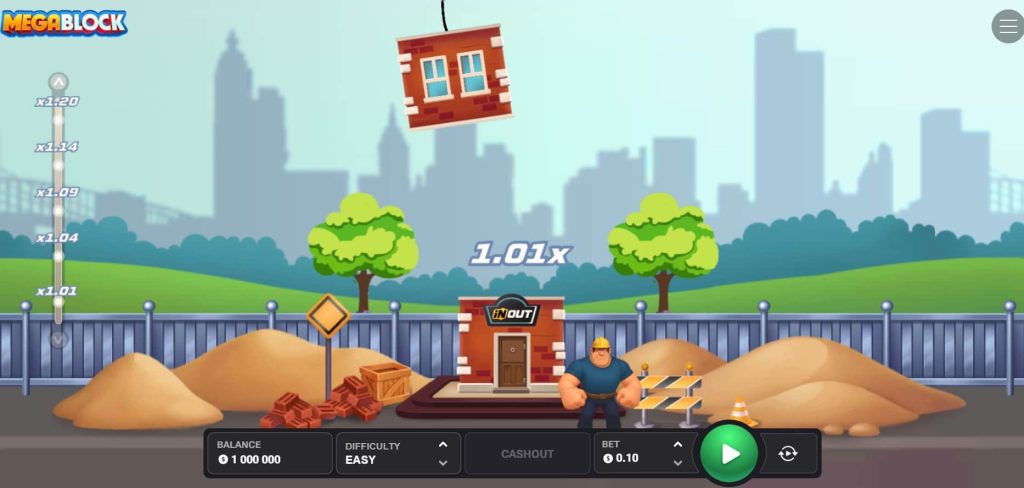
Visually, the game leans into its construction theme without overdoing it. A cartoon city skyline sits in the background, a small brick house serves as your foundation, and the block swings in from above like it’s being lowered by a crane. It’s clean, readable, and — crucially — never distracting. When the multiplier starts climbing, you want your eyes on the number, not on the background.
MegaBlock game at a Glance
Before diving deeper into how the game plays and what makes it tick, it helps to have the key facts in one place. The table below covers everything from the basics like RTP and bet range to the details that actually matter when you’re deciding whether MegaBlock fits your playing style.
| Detail | Info |
|---|---|
| Game Title | MegaBlock |
| Developer | InOut Games |
| Release Date | February 10, 2026 |
| Game Type | Instant Crash / Tower Builder |
| RTP | 95.5% |
| Volatility | Variable (depends on difficulty) |
| Difficulty Modes | Easy, Medium, Hard, Hardcore |
| Min Bet | $0.10 |
| Max Bet | $200.00 |
| Max Win (Easy) | x23.75 |
| Max Win (Medium) | x2,116 |
| Max Win (Hard) | x48,348 |
| Max Win (Hardcore) | x2,941,884 |
| Provably Fair | Yes |
| Free Demo | Yes |
| Mobile Compatible | Yes |
| License | Anjouan Gaming Board |
The numbers in the difficulty rows tell the real story here. The gap between Easy and Hardcore is enormous — not just in multiplier potential but in everything that flows from that choice: how long rounds last, how much pressure each drop carries, and how quickly a session can go either way. That variability is what gives MegaBlock a longer shelf life than most titles in this category, and it’s worth keeping in mind before the first round even starts.
RTP and Volatility – What the Numbers Actually Mean
MegaBlock game runs on a 95.5% RTP, which sits slightly below the industry average for crash-style games but is by no means unusual for a title with this level of multiplier potential. In practical terms, the RTP figure tells you what the game returns over a very large number of rounds — it is a long-term statistical measure, not a round-by-round guarantee. A single session can look very different from what the RTP suggests, in either direction.
What makes MegaBlock genuinely interesting from a volatility standpoint is that the game does not lock you into a single risk profile. Instead, volatility is directly tied to the difficulty mode you select before each round. This is a relatively rare design choice and one that has meaningful practical implications. It means that the same game can behave like a low-volatility title in one round and an extremely high-volatility one in the next, depending entirely on what you choose. The four modes effectively give you four different games under one roof, each with its own risk-reward balance and its own pace.
The relationship between difficulty, volatility, and RTP works as follows:
| Difficulty | Volatility Profile | Max Blocks | Max Multiplier |
|---|---|---|---|
| Easy | Low | 24 | x23.75 |
| Medium | Medium | 22 | x2,116 |
| Hard | High | 20 | x48,348 |
| Hardcore | Extreme | 15 | x2,941,884 |
Easy mode offers the most forgiving experience — more blocks per round, lower multipliers, and a steadier ride overall. Hardcore flips everything on its head: fewer blocks, far less margin for error, but a multiplier ceiling that is in a different league entirely. The volatility you experience is therefore not something the game imposes on you, but something you actively choose. That distinction matters, especially for players who like to adjust their approach based on their current bankroll or mood.
Multipliers and Difficulty Levels – How the Reward System Works
The multiplier system in MegaBlock is straightforward in principle and increasingly tense in practice. Every block that lands successfully adds to the tower and pushes the multiplier upward. The multiplier does not grow at a fixed rate — it scales based on the difficulty mode in play, which means the same number of successful placements will yield very different results depending on which mode you chose at the start of the round.
Understanding how each difficulty level behaves is arguably the most important thing a new player can do before committing real money. Here is what each mode actually offers:
- Easy – The entry point for new players and those who prefer steady, low-pressure sessions. With up to 24 blocks available and a maximum multiplier of x23.75, Easy mode is where you build confidence with the timing mechanic without too much on the line. Rounds tend to last longer, and the multiplier climbs gradually. The ceiling is modest, but the floor is forgiving.
- Medium – The middle ground where most experienced players spend the majority of their time. The block limit drops to 22 and the maximum multiplier jumps significantly to x2,116. The pace tightens, the margin for error narrows, and the rewards start to feel meaningful. Medium is where the game’s tension properly kicks in for the first time.
- Hard – A serious step up. With 20 blocks and a maximum multiplier of x48,348, Hard mode demands precise timing and a clear head. Each placement carries noticeably more weight than in the lower modes, and the decision of when to cash out becomes genuinely difficult as the multiplier climbs into territory that is hard to walk away from.
- Hardcore – The upper limit of what MegaBlock game offers. Only 15 blocks stand between you and a multiplier of x2,941,884 — a number that is difficult to process until you see it on screen. Hardcore is not a mode for casual rounds or for players still learning the timing. It is built for those who understand the game well, have a clear bankroll plan, and are comfortable with the reality that rounds here can end very quickly and very decisively.
One practical point worth noting: the difficulty mode can be changed between rounds, which means there is nothing stopping a player from warming up in Easy before moving to Hard, or from stepping back down after a rough sequence in Hardcore. That flexibility is one of the smarter design decisions in MegaBlock and gives the game a dynamic quality that fixed-volatility titles simply cannot match.
How to Play MegaBlock – From First Round to First Cashout
MegaBlock is one of the easier crash-style games to pick up, but like most titles in this category, the gap between understanding the rules and playing with confidence is wider than it first appears. The mechanic itself takes about thirty seconds to grasp — the timing, the discipline, and the decision-making take considerably longer. The following steps walk through everything from opening the game to completing a round, including the details that are easy to miss on the first few attempts.
- Choose a casino or open the demo – MegaBlock is available through online casinos that carry InOut Games titles, as well as in free demo form directly via the InOut Games website. If it is your first time playing, the demo is the right starting point. All game features work identically to the real-money version, and there is no registration required to access it.
- Set your bet amount – Before the round begins, select how much you want to wager. MegaBlock game accepts bets from $0.10 up to $200.00 per round. Start conservatively until you are comfortable with the timing mechanic — the block drops quickly and early rounds have a way of ending faster than expected.
- Select your difficulty mode – This is the most consequential decision you make before each round. Easy, Medium, Hard, and Hardcore each offer a completely different risk and reward profile. New players should begin with Easy to get a feel for the block physics and timing before moving up. The difficulty can be changed freely between rounds.
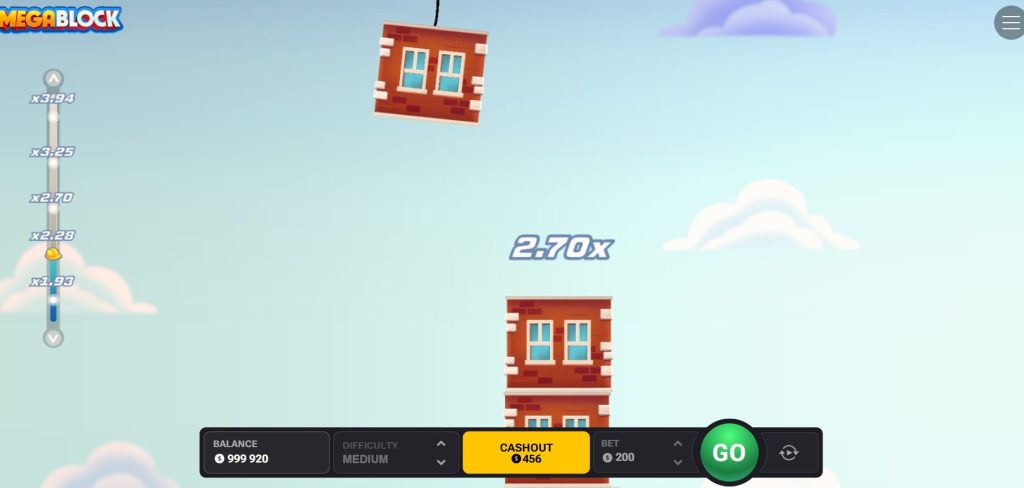
- Press Go to drop the block – Once your bet and difficulty are set, hit the Go button. The block suspended above your tower will drop. If it lands cleanly on the structure below, the round continues and the multiplier increases. If it misses, the round ends immediately and your bet is lost. The entire outcome of each placement comes down to your timing.
- Decide when to cash out – At any point after the first successful placement, you can hit the Cashout button to lock in your current multiplier and collect your winnings. There is no automated mechanic that does this for you — the decision is entirely yours. Cash out too early and you leave money on the table. Wait too long and a missed block wipes the round.
- Use autoplay for longer sessions – MegaBlock includes an autoplay function that allows you to set parameters for automatic rounds. This is useful for players who prefer a more systematic approach, but it is worth configuring carefully — autoplay removes the moment-to-moment decision of when to cash out, so the settings you choose matter more than they might seem.
- Review the round and adjust – After each round ends, take a moment before immediately starting the next one. Did the difficulty feel right for your current bankroll? Was the timing where you expected it to be? Mega Block rewards players who pay attention to their own patterns as much as it rewards those who simply get lucky with the drops.
The learning curve in MegaBlock crash is mostly about timing and self-discipline rather than complex rules. Once those two things click, the game opens up considerably — and the higher difficulty modes start to look a lot more appealing.
Tips to Improve Your Results in Mega Block
Winning in MegaBlock game ultimately comes down to a combination of timing, discipline, and smart decision-making before and during each round. There is no method that guarantees a profit — the block placement outcomes are provably fair and random — but there are habits and approaches that consistently separate players who manage their bankroll well from those who burn through it quickly. The following tips are grounded in how the game actually works rather than in speculation.
- Start with the demo before playing for real money – MegaBlock’s timing mechanic feels different in practice than it looks on paper. The demo gives you access to all four difficulty modes with no financial risk whatsoever. Use it to find the difficulty level that feels natural before a single real bet is placed. A few dozen practice rounds in the demo will save you from expensive mistakes in the first real-money session.
- Match your difficulty mode to your bankroll – Easy mode with a $50 bankroll is a very different proposition to Hardcore with the same amount. The difficulty you choose directly determines how quickly rounds can end and how fast your balance can move in either direction. As a rule of thumb, the smaller your session budget relative to your bet size, the lower the difficulty should be.
- Set a cashout target before each round begins – Deciding in advance at which multiplier you intend to cash out removes one of the most common failure points in crash-style games: the tendency to hold on for just one more floor. A pre-set target does not need to be rigid, but having one means your cashout decisions are made with a clear head rather than in the heat of the moment.
- Do not chase losses by jumping difficulty modes – After a losing streak on Medium, switching to Hard or Hardcore to recover faster is one of the most reliable ways to accelerate losses rather than reverse them. Higher difficulty means higher variance, which means results become less predictable exactly when predictability matters most. Moving down in difficulty after a rough sequence is nearly always the more sensible adjustment.
- Use autoplay carefully and with defined limits – Autoplay is a useful tool for consistent, systematic play, but it removes the moment-to-moment cashout decision from your hands entirely. If you use it, configure the stop conditions thoroughly — set win limits, loss limits, and a maximum number of rounds. Running autoplay without limits in a high-volatility mode is one of the faster ways to exhaust a bankroll without noticing.
- Pay attention to your cashout timing across sessions – MegaBlock rewards players who develop a consistent sense of when to walk away from a round. If you find yourself regularly cashing out at x1.5 on Medium when the mode supports multipliers into the hundreds, you are likely leaving significant value behind. Equally, if you consistently hold too long and miss, the problem is on the other end. Tracking your own patterns over time is more useful than any external strategy.
- Treat each round as independent – The block that swings above your tower has no memory of what happened in the previous round. A miss does not make the next placement more likely to succeed, and a long successful run does not mean a miss is overdue. Approaching each round on its own terms, rather than as part of a streak narrative, is one of the more underrated aspects of playing crash games consistently well.
The clearest advantage MegaBlock game gives players over most crash titles is the ability to choose their own volatility level. Used deliberately, that single feature is worth more than any betting system — because it means you are not just reacting to the game, you are actively shaping the conditions under which you play it.
MegaBlock Strategies – How to Approach Each Round
Mega Block is at its core a game of timing and nerve, but the betting decisions that surround each round are where strategy actually lives. No system can influence where the block lands or when a miss occurs — the outcome of each placement is determined by an RNG and is beyond any player’s control. What a strategy can do is shape how you manage your bankroll across multiple rounds, how aggressively you chase losses or protect gains, and how long a session realistically lasts given your starting budget. The three approaches below are the most commonly used and each suits a different type of player.
Flat Betting
The simplest approach and, for most players, the most sustainable one. Flat betting means placing the same wager every round regardless of what happened in the previous one — a win does not increase the next bet, and a loss does not either. The appeal is straightforward: your bankroll depletes at a predictable rate, sessions last longer, and there is no compounding risk from chasing losses or overextending after a good run. For MegaBlock specifically, flat betting pairs well with a fixed difficulty mode, giving you a consistent experience where the only variable is the timing of each cashout. It is the recommended starting point for anyone new to the game.
Martingale
The Martingale system is one of the oldest betting strategies in gambling and works on a simple principle: double your bet after every loss, and return to your base stake after every win. The logic is that a single win will always recover all previous losses and return a profit equal to the original bet. In theory it is clean. In practice it carries serious risk, particularly in a game like MegaBlock crash, where a short losing streak on Hard or Hardcore can escalate bets to uncomfortable levels very quickly.
The Martingale works best here on Easy mode with a conservative base stake and a clearly defined stop-loss limit — a maximum number of consecutive doubles beyond which you walk away rather than continuing to escalate. Without that limit, the system has no natural floor.
Paroli
Where Martingale chases losses, Paroli chases wins. The system works in the opposite direction: keep your base bet flat after a loss, and double it after each win. After three consecutive wins — or at whatever point you decide to stop — return to the base stake and begin again. The Paroli approach is considered lower risk than Martingale because you are only ever increasing bets when you are already ahead, meaning losing streaks cost you nothing beyond the flat base stake.
In the MegaBlock game, this translates well to Medium difficulty, where multipliers are meaningful enough that a short winning run at doubled stakes produces a noticeable result without the all-or-nothing exposure of the higher modes. The main discipline required is knowing when to reset — the temptation to extend a winning run beyond the planned stopping point is where the system most often breaks down.
Try MegaBlock for Free – The Demo Version
InOut Games makes the Mega Block demo available directly on their official website, and it is one of the more generous demo implementations you will find in this category. No account, no deposit, no strings attached — the game loads with a virtual balance and every feature works exactly as it does in the real-money version. That includes all four difficulty modes, the full multiplier range, and the cashout mechanic. For a game where timing is everything, having access to an unrestricted practice environment is genuinely useful rather than just a marketing checkbox.
The demo is also the most honest way to find out whether MegaBlock suits your playing style before any money changes hands. The block physics, the speed of each drop, and the pace at which the multiplier climbs are all things that read very differently on paper compared to how they feel in real time. A few rounds in Easy mode will tell you more about whether the timing mechanic clicks for you than any written description can. And if Easy feels too slow, switching to Medium or Hard in the demo costs nothing — which makes it the ideal environment to find the difficulty level that actually fits before committing real stakes to that decision.
MegaBlock Casinos to play at
Mega Block is distributed through InOut Games’ aggregator network, which means it reaches a large number of casino platforms without each one needing a separate direct deal with the developer. In practice, most casinos that already carry InOut Games titles like Chicken Road will have the MegaBlock slot in their lobby as well. The table below covers a selection of reputable platforms where the game is available or highly likely to be, along with the key details that matter when choosing where to play.
| Casino | License | Welcome Bonus | Min Deposit |
|---|---|---|---|
| Casino | License | Welcome Bonus | Min Deposit |
| Stake.com | Curaçao | Rakeback & promotions | $1 |
| 1win | Curaçao | Up to $1,720 | $1 |
| Mystake | Curaçao | Up to €600 | $10 |
| BC.Game | Curaçao | Up to 360% | $10 |
| Rollbit | Curaçao | Rakeback system | $1 |
| 888Starz | Curaçao | Up to $400 | $10 |
| Megapari | Curaçao | Up to €1,550 | $1 |
| Gamdom | Curaçao | Rakeback & rain | $1 |
A quick note worth keeping in mind: because MegaBlock launched in February 2026 and InOut Games is still actively expanding its distribution, the game’s availability may vary slightly by platform and region. The safest approach is to use the search function within your chosen casino’s lobby to confirm Mega Block is listed before depositing. All platforms in the table above carry InOut Games titles and operate under a valid Curaçao license.
MegaBlock on Mobile – Play Anywhere, No Download Needed
Mega Block runs entirely in the browser, which means there is nothing to install. Open your casino of choice on any modern smartphone or tablet, find the game, and it loads directly — on Android, iOS, or anything else with a halfway decent browser and a stable connection. InOut Games built the entire catalogue in HTML5 specifically for this reason, and MegaBlock game is no exception. The interface scales cleanly to smaller screens, the Go and Cashout buttons are large enough to tap accurately under pressure, and the cartoon construction site visuals hold up well at mobile resolutions without looking cluttered.
Performance is generally smooth on mid-range and above devices. Rounds are short by nature, which also means the game is well suited to mobile sessions — a few minutes of play between other things feels natural rather than interrupted. For players who prefer using a dedicated casino app rather than the mobile browser, most platforms that carry MegaBlock offer their own downloadable app, through which the game is equally accessible. Either way, the experience is the same — no features are locked to desktop, and no compromises are made on the mobile version.
Final Thoughts – Is MegaBlock Worth Your Time?
MegaBlock slot is one of those games that is harder to put down than it looks. On the surface it is almost disarmingly simple — a block swings, you press a button, it lands or it doesn’t. But the combination of a genuine timing element, a difficulty system that puts real control in your hands, and a multiplier ceiling that climbs into genuinely extraordinary territory on the higher modes gives the game a depth that most crash-style titles never quite reach. It is not a passive experience. Every round asks something of you, even if that something is just knowing when to walk away.
The difficulty system deserves particular credit because it is the design decision that makes everything else work. Without it, MegaBlock would be a competent but fairly standard instant game. With it, the game becomes four different experiences depending on what you need from a session — a relaxed low-stakes run on Easy, a focused medium-volatility grind on Medium, or the white-knuckle tension of Hard and Hardcore where the multipliers get genuinely difficult to comprehend. That kind of built-in flexibility is rare and it is what gives Mega Block a longer shelf life than most of its competitors.
For new players, the recommendation is straightforward: start with the free demo, spend time on Easy and Medium before touching the higher modes, and treat the difficulty selector as the most powerful tool the game gives you — because it is. For experienced crash game players, MegaBlock game offers something familiar enough to feel comfortable from the first round and different enough to stay interesting well beyond it.
FAQ
Is MegaBlock the same as a crash game?
MegaBlock shares the core tension of crash games — a growing multiplier, a decision about when to stop, and the risk of losing everything if you wait too long — but it plays differently enough to be its own thing. In a traditional crash game the multiplier climbs automatically and you cash out manually. In MegaBlock the multiplier advances through active block placements, each one carrying its own risk of ending the round. The result is a game that feels more interactive and physical than most crash titles, closer to a skill-arcade hybrid than a passive watch-and-react experience.
Can I play MegaBlock for free without registering anywhere?
Yes. InOut Games provides a fully functional demo version directly on their official website at inout.games, accessible without creating an account or providing any personal details. The demo includes all four difficulty modes and the complete multiplier range, making it a genuine representation of the full game rather than a stripped-down preview. Several third-party casino review sites also embed the demo directly on their pages if you prefer not to navigate to the developer’s site.
What is the best difficulty mode for beginners?
Easy mode is the right starting point for anyone new to MegaBlock. It offers up to 24 block placements per round, the most forgiving block physics, and a lower-pressure multiplier progression that gives you time to get comfortable with the timing mechanic before the stakes feel real. Once Easy starts to feel routine — typically after a few dozen rounds — Medium is a natural next step. The jump in multiplier potential is significant and the tighter margin for error is immediately noticeable, but the core skills developed in Easy transfer directly.
Does MegaBlock use provably fair technology?
Yes. Like all InOut Games titles, MegaBlock operates on a provably fair system, meaning every round outcome can be independently verified using cryptographic methods. Each result is determined by a combination of a server seed, a client seed, and a nonce, all of which can be checked after the fact to confirm the outcome was genuinely random and unmanipulated. For players who prioritise transparency — particularly those coming from a crypto gambling background — this is one of MegaBlock’s more meaningful credentials.
What is the maximum I can win in a single round of MegaBlock?
The maximum payout is capped at $20,000 per round regardless of difficulty mode. However, the multiplier ceiling varies significantly by difficulty — up to x23.75 on Easy, x2,116 on Medium, x48,348 on Hard, and a theoretical x2,941,884 on Hardcore. In practice, the $20,000 cap means that the extraordinary Hardcore multipliers are only fully realisable at very low bet sizes. At a $0.10 bet, the Hardcore ceiling translates to a theoretical maximum of $294,188 — but the platform cap of $20,000 applies regardless, so bet sizing relative to difficulty is worth thinking through before each session.